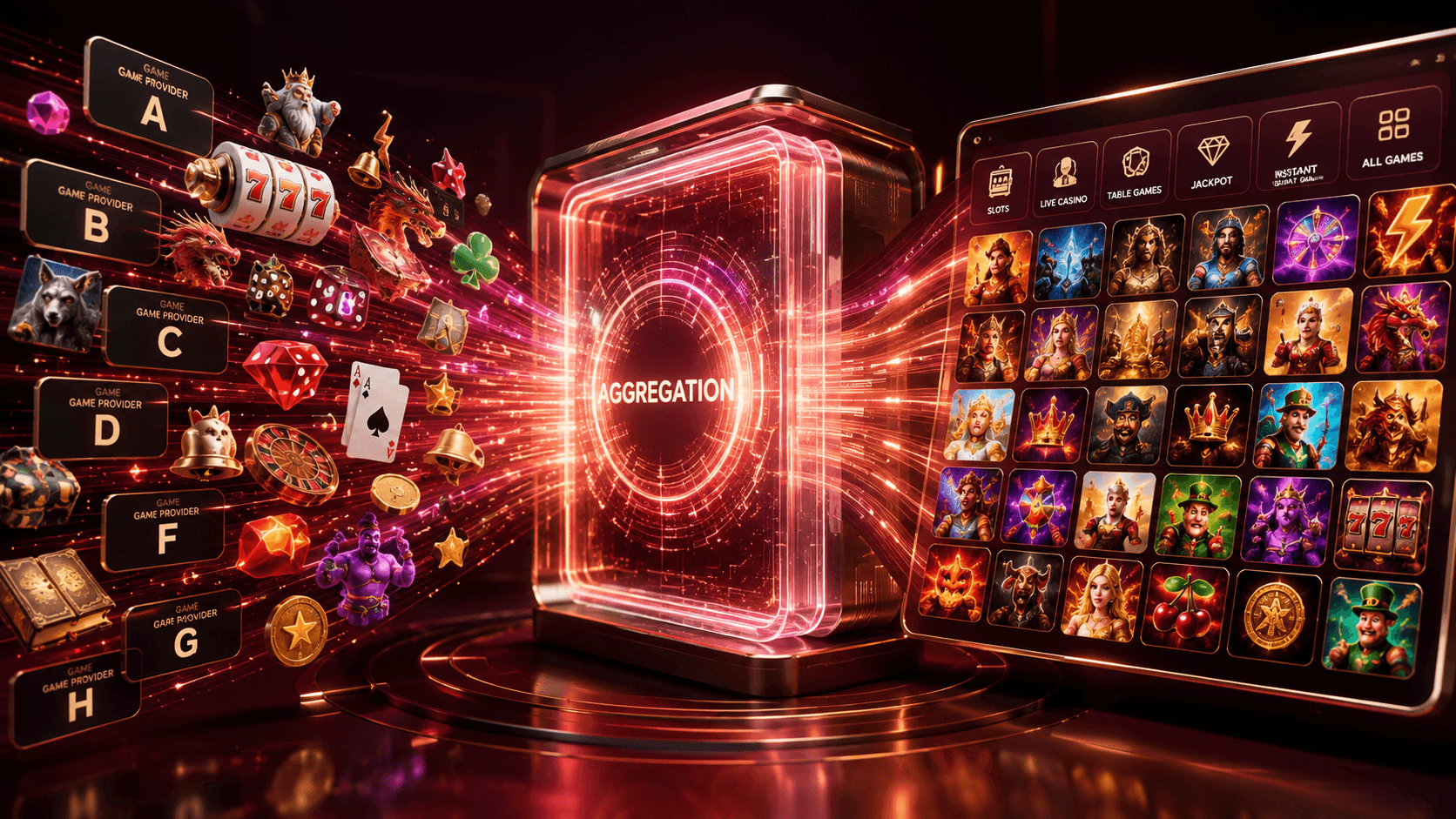
Open almost any large online casino today and the size of the game library can be surprising. Hundreds, sometimes thousands, of slots, live casino tables, crash games, instant-win titles, and other products can all appear inside a single platform.
At first glance, it might seem as though the casino has individually connected with every studio responsible for those games.
Usually, the technology behind the scenes is more complicated, and much more efficient.
One important part of this infrastructure is the casino game aggregator.
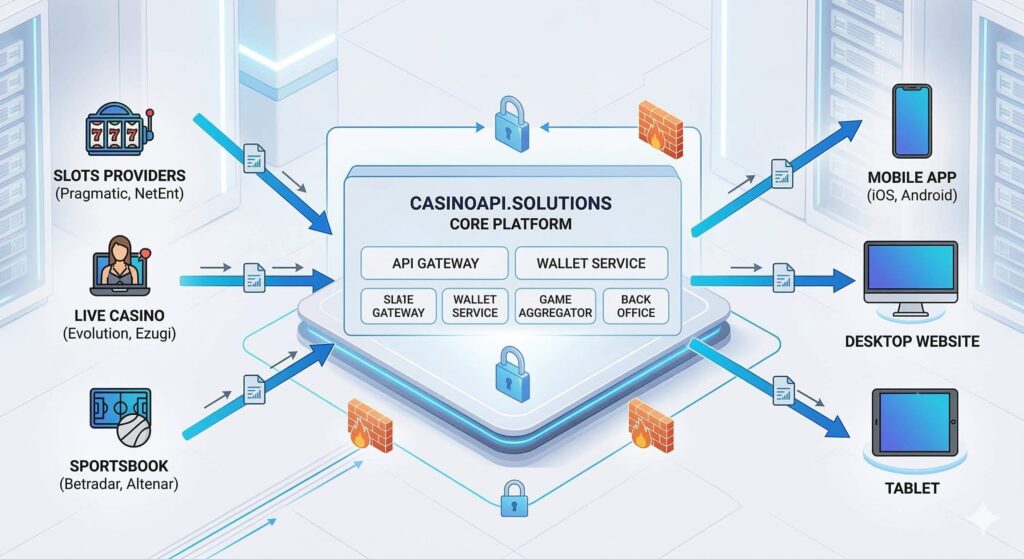
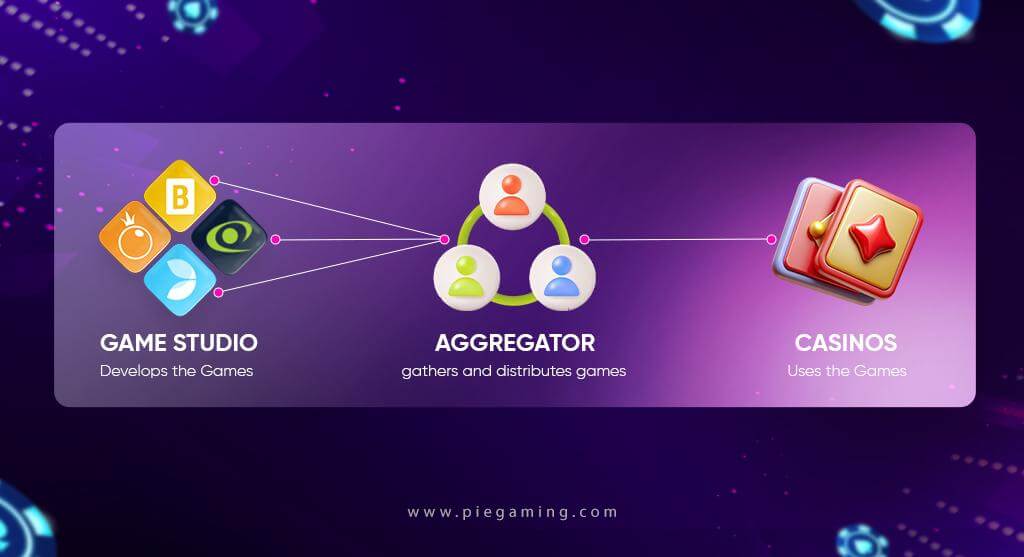
Aggregators act as a technological bridge between casino operators and game providers. Instead of a platform building and maintaining a separate technical integration for every studio, an aggregation service can provide access to many providers through a single connection.
For players, most of this infrastructure is invisible. They simply open a casino lobby, select a game, and start playing.
Behind that simple action, however, multiple systems may be communicating with each other.
Understanding aggregation helps explain why modern casino libraries have become so large, why completely different casinos can offer many of the same games, and why the experience of launching the same title can sometimes vary from one platform to another.
What Is a Casino Game Aggregator?
A casino aggregator is essentially an intermediary between game providers and casino platforms.
Imagine that a casino wants games from 40 different studios.
Without aggregation, the operator may need to establish and maintain separate technical connections with numerous providers.
Conceptually, that might look like:
Casino → Provider A
Casino → Provider B
Casino → Provider C
Casino → Provider D
Continue that process across dozens of studios and the technical environment becomes increasingly complicated.
An aggregator changes the structure.
Instead, it can look more like:
Casino → Aggregator → Multiple Game Providers
Through one central integration layer, the casino can gain access to a much broader catalog of games.
The aggregator does not necessarily create the games. Its role is primarily to help distribute and connect content from different providers.
Why Do Casinos Use Aggregators?
Scale is one of the biggest reasons.
Modern players expect variety.
A casino offering only a small number of titles may struggle to compete with platforms containing thousands of options across categories such as:
- slots
- live casino
- table games
- crash games
- jackpots
- instant-win games
- specialty games
Building direct integrations with every provider can require substantial technical work.
Each provider may have its own systems, updates, requirements, and game catalog.
Aggregation can simplify this process by giving the casino a more centralized way to access content.
For players, the result is straightforward: more games can appear inside one lobby.
How Does the Technology Work?
The exact infrastructure varies between companies, but aggregators commonly rely on APIs and other integration technologies to connect casino platforms with game providers.
When a player selects a game, several things may need to happen.
The platform needs to know:
- which game was selected
- which provider supplies it
- whether it is available in that market
- which currency is being used
- whether the player is authenticated
- how the game session should be launched
The aggregation layer helps coordinate communication between systems.
From the player’s perspective, the experience can appear almost instantaneous.
Click the game.
Wait briefly.
Play.
But that simple launch may involve communication between the casino platform, aggregation infrastructure, game provider, and other supporting services.
Why Can Two Casinos Have Almost Identical Games?
Aggregation helps explain one of the most noticeable characteristics of modern online gambling.
Visit two unrelated casinos and you may find many of the same titles.
This does not necessarily mean one casino copied the other.
Both may simply have access to overlapping provider catalogs.
If several operators integrate with an aggregator offering games from the same major studios, their libraries will naturally share a significant amount of content.
This is similar to digital entertainment platforms.
Different streaming or gaming services may distribute content created by the same outside studios. The platform provides access, while the underlying content originates elsewhere.
Casino aggregation follows a comparable principle.
The Casino Lobby Still Matters
If operators can access many of the same games, an interesting question emerges:
What makes one casino library different from another?
Increasingly, the answer is organization.
Two casinos might contain hundreds of identical titles but present them very differently.
One platform might emphasize:
- new releases
- trending games
- jackpots
- specific providers
Another might organize games around:
- volatility
- themes
- player preferences
- recently played titles
- personalized recommendations
This means the value of a casino library is not determined solely by its size.
Discovery becomes important too.
A library containing 5,000 games is not necessarily useful if players cannot easily find something they want to play.
Aggregation Has Helped Game Libraries Grow
The expansion of aggregation technology has made extremely large casino catalogs more practical.
Instead of treating every new studio as an entirely separate technical project, operators can potentially access additional content through an existing aggregation relationship.
This creates a much more scalable model.
As aggregators expand their catalogs, connected casinos may gain access to:
- new providers
- new releases
- regional content
- specialized game categories
For players, this creates the impression of constantly expanding libraries.
New games can appear frequently without requiring the casino itself to develop them.
Smaller Providers Can Benefit Too
Aggregation is not only useful for casinos.
It can also help game studios reach broader audiences.
A smaller developer may create an excellent slot or instant game but lack direct relationships with hundreds of casino operators.
Connecting to an aggregation network can potentially give that studio access to a wider distribution ecosystem.
This creates an interesting dynamic.
Large providers benefit from enormous brand recognition, but smaller studios can gain visibility through the same casino libraries.
Players may discover games from developers they had never encountered before simply because those titles appeared alongside familiar providers.
If you want to explore some of the studios benefiting from this increasingly diverse market, Next-Gen Slot Providers You Need to Know in 2025 looks at newer providers and the ideas helping them compete with established names.
Aggregation can therefore increase both variety and discoverability.
More Games Does Not Always Mean a Better Experience
Thousands of available games sound impressive.
But enormous libraries create their own problem.
Choice overload.
If a player opens a casino and sees 4,000 titles without meaningful organization, the selection process can become frustrating.
This is why modern casinos increasingly invest in:
- search
- filtering
- recommendations
- categories
- favorites
- recently played lists
Aggregation solves the supply problem.
It does not automatically solve the discovery problem.
As libraries continue expanding, finding the right game becomes increasingly important. Casino Search Engines – How Players Will Discover Games Differently in 2026 explores how smarter filters, provider sorting, volatility-based searches, and personalized lobbies could make these enormous catalogs easier to navigate.
The more content a platform adds, the more important navigation becomes.
Availability Can Differ Between Markets
A game appearing inside an aggregator’s catalog does not necessarily mean every player can access it.
Online gambling operates across many regulatory jurisdictions.
Availability can depend on factors such as:
- local regulation
- provider licensing
- operator licensing
- commercial agreements
- currency support
- regional restrictions
As a result, two players using related casino platforms in different countries may see different game libraries.
A title available in one market may be absent in another.
This is another reason casino catalogs can look similar without being completely identical.
Why Games Sometimes Disappear
Players occasionally notice that a game they previously played is no longer available.
Aggregation helps explain why catalogs can change.
Games may disappear because of:
- provider decisions
- licensing changes
- regulatory restrictions
- technical updates
- commercial changes
- market availability
The casino lobby is therefore not necessarily a permanent collection.
It is a dynamic catalog connected to a wider network of providers and systems.
Titles can be added, updated, restricted, or removed over time.
Does Aggregation Affect Loading Speed?
Potentially, but the relationship is not as simple as saying aggregators make games faster or slower.
Game performance can depend on several factors, including:
- provider infrastructure
- server location
- network conditions
- casino platform performance
- device capability
- browser performance
- internet connection
The aggregation layer is another component in the overall delivery chain.
Well-designed infrastructure should make the process feel seamless.
Poor optimization anywhere in that chain can create delays.
For players, this is why the same game may sometimes feel slightly different when accessed through different platforms, even though the underlying title comes from the same provider.
The Same Game Can Still Feel Different
The game itself may be identical, but the surrounding experience can vary significantly.
One casino might provide:
- faster navigation
- cleaner search
- better mobile optimization
- easier account management
- clearer game information
Another might offer the same title inside a cluttered or slower interface.
This highlights an important distinction.
The game provider controls the game, but the operator heavily influences the experience around it.
Aggregation brings content into the platform.
The casino still determines how effectively that content is presented to players.
Aggregators Can Support Multiple Game Categories
Modern aggregation is not limited to traditional slots.
Depending on the service, a catalog may contain content from several categories.
These can include:
- slots
- live dealer games
- table games
- crash titles
- virtual games
- instant games
This helps casinos create more diverse entertainment libraries without building each category internally.
For players, the platform can feel like one unified destination even though its content may come from dozens of independent companies.
What Players Rarely See
When someone launches a slot, they usually see:
Casino → Game
Behind the scenes, the structure may be closer to:
Player → Casino Platform → Aggregation Layer → Game Provider → Game Session
Additional services can also be involved depending on the platform.
The impressive part is that players generally do not need to understand any of this.
Good infrastructure makes complexity invisible.
If everything works correctly, the player simply presses a game tile and the title loads.
Why Aggregation Makes Casino Libraries Look Similar
Aggregation has also contributed to a certain level of standardization across the industry.
If many operators gain access to the same major provider catalogs, game selection alone becomes less effective as a differentiator.
This pushes casinos to compete in other areas.
These include:
- UX
- personalization
- payments
- promotions
- customer service
- game discovery
- loyalty features
In other words, having thousands of games is becoming less remarkable.
What matters increasingly is what the casino does with them.
Could Aggregation Become Even More Invisible?
The future of aggregation is likely to involve even tighter integration.
Players probably will not care which technical route delivers a game.
Instead, they will expect:
- fast launches
- consistent interfaces
- personalized discovery
- reliable availability
- seamless mobile performance
Artificial intelligence may also make enormous aggregated catalogs easier to navigate.
Rather than browsing thousands of games manually, players could receive increasingly precise recommendations based on preferences such as:
- theme
- volatility
- provider
- mechanics
- session style
Aggregation provides the content supply.
Personalization may increasingly determine which part of that supply each player actually sees.
Does the Biggest Library Win?
Not necessarily.
At some point, adding another thousand games provides diminishing value if players cannot distinguish between them.
The next stage of competition may therefore focus less on how many games a casino has and more on how intelligently those games are presented.
A well-organized catalog of 2,000 games could potentially feel more useful than a poorly organized library of 10,000.
For players, relevance often matters more than raw quantity.
Final Thoughts
Casino aggregators are one of the most important pieces of online gambling infrastructure that most players never see.
They help connect casino platforms with multiple game providers through centralized integration technology, making it possible for operators to build enormous libraries without treating every provider as an entirely isolated system.
Aggregation helps explain why modern casinos can offer thousands of titles and why competing platforms frequently contain many of the same games.
For players, the benefits can include greater variety, access to more providers, frequent new releases, and broader game categories.
But aggregation also creates new challenges.
Huge libraries require better search, stronger recommendations, clearer categories, and more thoughtful navigation. Availability can vary by market, and the experience surrounding the same game can differ considerably between casinos.
Ultimately, aggregators demonstrate how much technology sits behind a seemingly simple casino lobby.
What appears to be one enormous collection of games is often actually a network of platforms, providers, and infrastructure working together.
Players may never see those connections.
But every time thousands of games appear under one digital roof, aggregation is likely to be part of the reason why.
Sources: