
One of the biggest differences between traditional sports betting and modern online sportsbooks is that bettors no longer necessarily have to wait until an event finishes to settle their wagers.
The cash-out feature allows participants to close an active bet before its final outcome is determined. Depending on how the event is progressing, they may receive more than their original stake, recover part of it, or accept a smaller return than the potential payout.
At first glance, cashing out appears to offer greater flexibility. A bettor can secure a profit before the final whistle, reduce a potential loss, or avoid the uncertainty of the remaining minutes of a match.
However, there is another side to the feature that is often overlooked.
Cash-out offers are calculated by sportsbooks using changing probabilities, live betting odds, pricing models, and commercial margins. The amount displayed is not necessarily the fair mathematical value of the remaining bet.
Cash out is not simply an exit button. It is a financial transaction in which a bettor exchanges an uncertain future payout for an immediate, guaranteed amount.
Understanding how that transaction works is essential to evaluating its advantages, limitations, and real cost.
What Is Cash Out in Sports Betting?
Cash out is a sportsbook feature that allows bettors to settle an eligible wager before its natural conclusion.
Instead of waiting for the final result, the bettor accepts an amount calculated by the sportsbook at that particular moment.
Once a full cash out has been successfully processed, the original bet is closed. Subsequent changes in the match or event no longer affect its payout.
For example, imagine someone places a $100 bet on a football team to win at decimal odds of 3.00.
The potential total payout is $300.
During the match, the selected team takes the lead, and the sportsbook offers a cash-out amount of $210.
The bettor now has two possible choices:
- Accept $210 immediately, securing a net profit of $110.
- Keep the original bet active, with a potential total payout of $300 if the team wins or a loss of the $100 stake if it does not.
Cash out removes the uncertainty associated with the remaining event, but it also removes the possibility of receiving the original full payout.
That trade-off is at the center of every cash-out decision.
The Three Main Types of Cash Out
Modern sportsbooks may offer several versions of the feature. Although availability varies between operators, the three most common formats are full cash out, partial cash out, and automatic cash out.
Full Cash Out
Full cash out closes the entire wager immediately once the request is successfully accepted.
Consider the following example:
Illustrative full cash-out example
Original stake
$100
Potential total payout
$300
Current cash-out offer
$210
Guaranteed net profit if accepted
$110
Additional potential payout forgone
$90
If the team eventually wins, the bettor receives no additional payment. If the team loses, the accepted $210 remains unaffected.
Full cash out provides certainty, but that certainty comes at the expense of the original bet’s remaining potential.
Partial Cash Out
Partial cash out allows bettors to settle a portion of their wager while leaving the remainder active.
Suppose a $100 bet has a potential total payout of $300 and a current full cash-out value of $210.
In a simplified example, the bettor chooses to cash out 50% of the position.
Original betting position 100%
50% settled
50% active
Immediate cash out
$105
Remaining potential payout
$150
Total received if the team wins
$255
Total received if the team loses
$105
Assumes proportional settlement. Actual partial cash-out calculations depend on sportsbook rules.
Partial cash out reduces the amount exposed to the final result without completely closing the wager.
However, the settled portion is still subject to the sportsbook’s cash-out pricing. Splitting a bet does not automatically improve its expected financial return.
Automatic Cash Out
Automatic cash out allows bettors to specify a cash-out target in advance.
For example, a bettor might configure a $100 wager to cash out automatically if its settlement value reaches $180.
If the sportsbook’s conditions are met and the request is successfully processed, the wager may be closed without requiring manual confirmation at that moment.
This feature can reduce the need to monitor an event continuously.
However, automatic cash out is not a guaranteed settlement instruction. Rapid odds changes, suspended markets, technical delays, and operator-specific rules can prevent it from being executed.
A displayed target should not be treated as a guaranteed minimum return.
How Do Sportsbooks Calculate Cash-Out Values?
Cash-out offers are primarily influenced by the current estimated probability of the original wager winning.
When a selection becomes more likely to succeed, its cash-out value generally increases. When its chances deteriorate, the value generally decreases.
Several factors can influence the calculation:
- The original stake and odds.
- The original potential payout.
- Current live betting odds.
- Changes in the score, remaining time, or match conditions.
- The sportsbook’s pricing model and commercial margin.
- Market availability and liquidity where relevant.
A simplified way to understand the theoretical value of an active bet is to multiply its potential total payout by its current estimated probability of winning.
\[ \text{Theoretical value}=\text{Potential payout}\times\text{Win probability} \]
Suppose a bet has a potential payout of $300 and its current estimated probability of winning is 70%.
Its theoretical expected settlement value would be:
\[ 300\times0.70=\$210 \]
However, the sportsbook might offer only $195.
The $15 difference represents a discount relative to that estimated theoretical value.
This simplified calculation assumes a bet with only two possible outcomes: a full win or a full loss. Bets involving refunds, pushes, dead heats, or partial settlements require additional calculations.
How Changing Odds Affect Cash-Out Offers

Live sports betting odds change throughout an event as new information becomes available.
A goal, injury, red card, weather change, or the passage of time can influence the estimated probability of a particular result.
Imagine a bettor places $100 on a football team at decimal odds of 3.00, creating a potential total payout of $300.
As the match progresses, the team’s live odds change.
| Match situation | Live decimal odds | Simplified estimated bet value |
| Before kick-off | 3.00 | $100.00 |
| Team takes the lead | 1.80 | $166.67 |
| Team scores again | 1.25 | $240.00 |
| Opponent reduces the deficit | 1.60 | $187.50 |
| Opponent equalizes | 3.50 | $85.71 |
| Team falls behind | 8.00 | $37.50 |
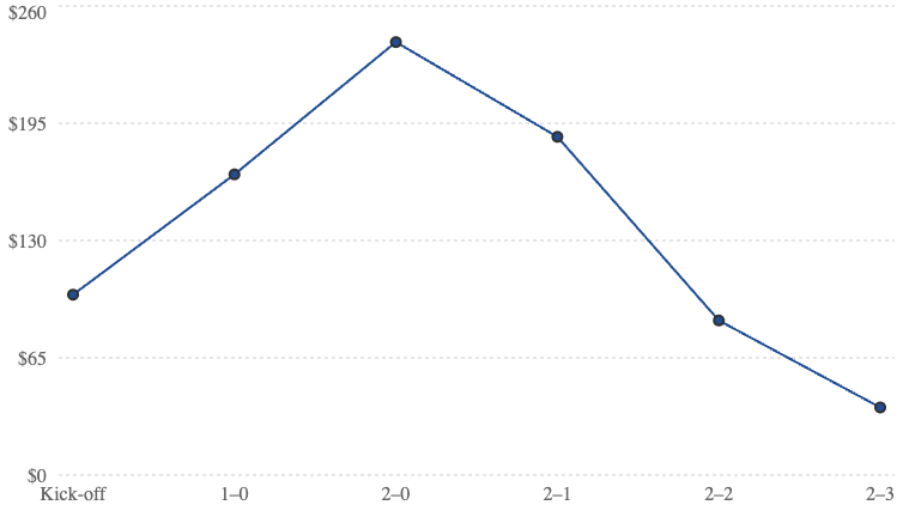
Illustrative values calculated by dividing the original potential payout by the current decimal odds. Actual cash-out offers can differ, and sportsbook odds include pricing margins.
The example demonstrates how an active bet can change in value several times during a single event.
A cash-out offer is therefore not a fixed amount attached to the original wager. It is a dynamic price that reflects the sportsbook’s current assessment of the position.
Why Is the Cash-Out Amount Usually Lower Than the Potential Payout?
This is one of the most common questions among beginners.
If a bettor could receive $300 from a winning bet, why would the sportsbook offer only $220 when the selected team is already leading?
The answer is that the original payout remains conditional.
Even if the team appears likely to win, there is still a possibility that the result will change.
A potential payout of $300 is not equivalent to $300 that has already been earned.
Suppose the team’s estimated probability of winning is 80%.
The theoretical value of the unresolved bet is $240.
If the sportsbook offers $225, two separate factors explain the difference.
Breaking down a hypothetical cash-out offer
Maximum potential payout
$300
Theoretical value at 80% probability
$240
Actual cash-out offer
$225
Reduction reflecting remaining uncertainty
$60
Additional pricing discount
$15
The first reduction reflects the fact that the bet has not yet won.
The second reflects the difference between the estimated theoretical value and the amount the operator is prepared to pay.
Understanding these two components helps bettors distinguish the cost of uncertainty from the potential cost of cashing out.
The Hidden Cost of Cash Out: Understanding Operator Margins
Sportsbooks generally incorporate a commercial margin into their betting odds.
This is one of the ways operators generate revenue over a large volume of wagers.
Cash-out pricing can introduce an additional disadvantage because the operator determines the amount offered to close an existing bet.
Although cash out is often presented as a convenience feature, it is not necessarily a financially neutral transaction.
A practical example
Imagine an active wager has a theoretical expected value of $250.
The sportsbook offers $230 to settle it immediately.
The difference is $20.
\[ \frac{250-230}{250}\times100=8\% \]
The cash-out offer is 8% below the estimated theoretical value.
The bettor is effectively accepting a discount in exchange for certainty.
This does not mean the sportsbook earns exactly $20 in profit from the transaction. Its actual financial position depends on the original wager, other liabilities, pricing, and the eventual result.
Nevertheless, from the bettor’s perspective, the offer is lower than the estimated value of the remaining position.
Is there a fixed cash-out fee?
Usually, the cost is not presented as a separate transaction fee.
Instead, it may be incorporated into the amount offered.
Different sportsbooks can use different pricing models, and cash-out discounts may vary between markets and events.
There is no universal percentage that applies to every cash-out transaction.
Cash-Out Value Calculator
The following calculator illustrates the relationship between a bet’s potential payout, its estimated probability of winning, and the sportsbook’s settlement offer.
Original stake ($)
Original decimal odds
Estimated probability of winning
80%
1%
50%
99%
Sportsbook cash-out offer ($)
Original potential payout
$300.00
Estimated theoretical value
$240.00
Cash-out net profit / loss
$125.00
Offer below theoretical value
$15.00
Educational illustration only. The probability is an assumption, not a verified forecast. This calculator does not account for refunds, taxes, promotions, or complex settlement rules.
The example shows why a profitable cash-out offer can still be lower than the estimated mathematical value of an active wager.
When Can Cash Out Be Useful?

Despite its potential cost, cash out can serve a legitimate purpose.
Financial decisions are not always based exclusively on maximizing expected returns. People may also value certainty, reduced exposure, and the ability to close an uncertain position.
Reducing potential losses
Imagine a bettor places $100 on a team that subsequently falls behind.
The sportsbook offers $35 to close the wager.
Accepting the offer means taking a $65 loss rather than remaining exposed to a possible $100 loss.
However, if the team eventually wins, the bettor will have surrendered the original potential payout.
Cash out limits further exposure, but it does not reverse the loss already incurred.
Securing an existing profit
A cash-out offer above the original stake allows a bettor to settle the wager with a positive net return.
This can remove uncertainty and end the financial involvement in an event.
The trade-off is that the bettor may receive less than the remaining position’s estimated value or its eventual winning payout.
Ending involvement in an event
Sometimes a bettor no longer wants to follow a match or remain financially invested in its outcome.
Cash out can provide an exit without waiting for the event to conclude.
In this situation, the value of ending the uncertainty may be more important to the individual than the possibility of receiving a larger payout.
When Can Cash Out Be Disadvantageous?
Cash out can become problematic when bettors misunderstand its pricing or use it repeatedly in response to emotional reactions.
Repeatedly accepting discounted offers
If cash-out offers consistently fall below the theoretical value of active wagers, accepting them frequently can reduce expected returns over time.
Even small pricing discounts can accumulate across many transactions.
Reacting to temporary changes
Sports events can change quickly.
A missed opportunity, temporary pressure from an opponent, or a sudden change in momentum can make a bettor feel uncomfortable.
However, emotional discomfort does not necessarily indicate that a cash-out offer represents good financial value.
Treating cash out as insurance
Some bettors assume that cash out protects them from losing money.
In reality, cash-out availability is conditional.
A sportsbook may suspend the feature precisely when the outcome becomes more uncertain.
The available amount may also fall dramatically before the bettor has an opportunity to accept it.
Cash out is not an insurance policy or a guaranteed safety mechanism.
Cash Out vs Keeping the Original Bet
The differences between the two approaches are relatively straightforward.
| Feature | Cashing out | Keeping the bet active |
| Financial outcome | Fixed once successfully settled | Depends on the final result |
| Remaining uncertainty | Removed for a full cash out | Continues until settlement |
| Maximum potential payout | Usually reduced | Original payout remains available |
| Additional pricing discount | May apply | No cash-out discount |
| Exposure to match developments | Removed for settled portion | Continues |
| Possibility of recovering from an unfavorable position | Removed for settled portion | Remains possible |
Neither approach guarantees a better financial result.
Cashing out prioritizes certainty. Keeping the bet active preserves its remaining potential and uncertainty.
Can You Cash Out an Accumulator Bet?
Many sportsbooks also offer cash out on accumulator bets, sometimes called parlays or multiples.
An accumulator combines several selections into one wager. In a conventional accumulator, all selections must win for the full payout to be awarded, subject to the operator’s settlement rules.
Imagine a bettor places $20 on a four-selection accumulator with a potential total payout of $400.
The first three selections win, leaving one unresolved event.
The sportsbook offers a cash-out amount of $170.
Illustrative four-selection accumulator
Selection 1
Won
Selection 2
Won
Selection 3
Won
Selection 4
Pending
Cash-out offer
$170
Potential total payout
$400
The offer reflects the remaining probability of the accumulator succeeding, together with the operator’s pricing.
The fact that three selections have already won does not mean the bettor has earned three-quarters of the potential payout.
The final selection can still determine whether the entire conventional accumulator wins or loses.
This is particularly important because accumulator cash-out decisions can involve large differences between the original stake, the immediate settlement offer, and the potential final payout.
Why Does the Cash-Out Button Sometimes Disappear?
Cash out is not available continuously on every wager.
Sportsbooks may temporarily suspend the feature when an event is undergoing a significant change or when reliable pricing becomes difficult.
Common examples include goals under review, penalties, red cards, injuries, sudden odds movements, and interruptions to live data feeds.
During these moments, the sportsbook may need to recalculate the probabilities associated with the wager.
Once the market becomes available again, the cash-out amount may be substantially different.
Some betting markets may not support cash out at all. Promotional wagers, free bets, and certain specialized markets can also be subject to restrictions.
Understanding how sportsbooks handle interrupted events and unresolved wagers is equally important. Our article What Happens When a Sports Event Is Cancelled? Understanding Bet Settlement Rules explains how postponements, cancellations, and other unexpected developments can affect betting settlements.
The exact conditions depend on the sportsbook.
What Happens If the Odds Change While You Are Cashing Out?
Cash-out requests are generally subject to confirmation.
A bettor may see an offer of $180, press the cash-out button, and then receive a revised offer of $165 because the odds changed before the transaction was completed.
In other circumstances, the request may be rejected entirely.
This can happen because live sporting events develop faster than the interface can process and confirm every transaction.
Until the sportsbook confirms that the wager has been successfully settled, it may remain active.
This distinction is especially important during fast-moving events.
Seeing a cash-out amount on the screen is not the same as having that amount credited to the account.
Cash Out and the Psychology of Regret
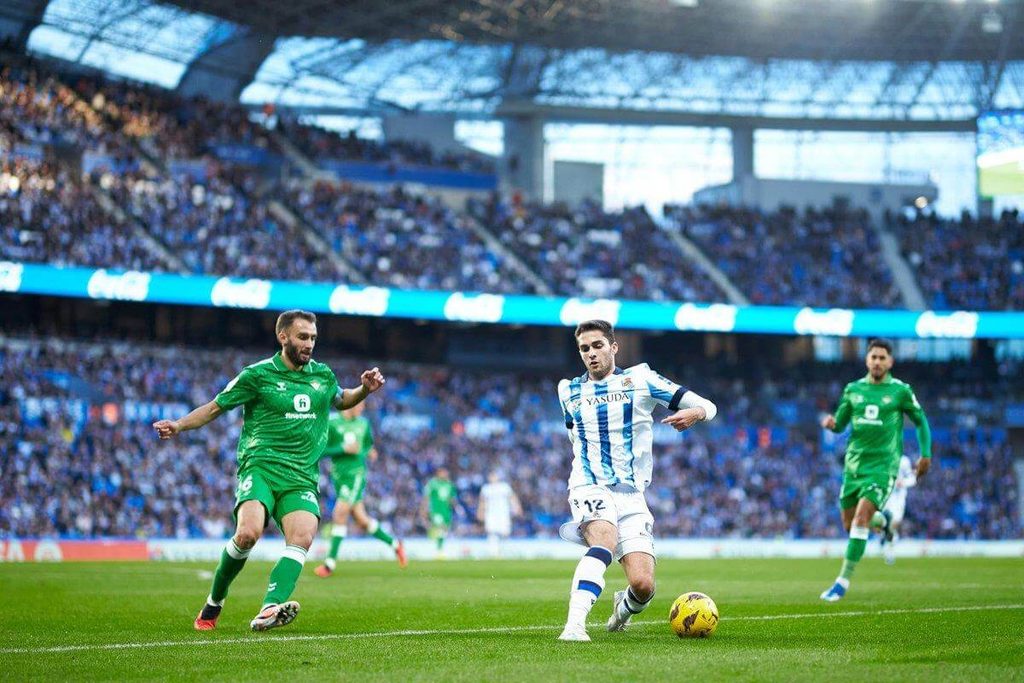
Cash-out decisions are particularly interesting from a psychological perspective because they create an opportunity for regret regardless of the outcome.
Imagine a bettor accepts $150 from a wager that could eventually pay $300.
If the bet wins, the bettor may regret cashing out.
If the bet loses, the bettor may feel that cashing out was an excellent decision.
However, both reactions rely on information that was unavailable when the original decision was made.
This is known as outcome bias: evaluating the quality of a decision primarily according to what happened afterward.
A financially reasonable decision can produce an unfavorable result. An unfavorable financial decision can occasionally produce a positive result.
The eventual match outcome alone does not establish whether the cash-out offer was fairly priced at the time.
The distinction between informed decision-making and actual financial outcomes is also explored in Skill Inflation in Gambling – Are Players Becoming More Strategic Over Time?, which examines the growing role of statistics, research, and perceived control in gambling decisions.
The influence of loss aversion
People often experience the emotional impact of losing money more strongly than the satisfaction of gaining an equivalent amount.
Cash out can interact with this tendency.
A bettor who sees an available profit may become increasingly concerned about losing it, even though the amount has not yet been settled.
Similarly, someone facing a potential loss may accept a discounted offer simply to escape the discomfort of uncertainty.
These emotional responses are understandable, but they should not be confused with evidence that a particular transaction improves the expected financial outcome.
Common Misconceptions About Cash Out
Cashing out guarantees a profit
Cash out guarantees only the confirmed settlement amount.
If that amount is below the original stake, the bettor has still lost money.
A cash-out offer reflects the exact fair value of a bet
Not necessarily. The sportsbook may incorporate additional pricing discounts or commercial margins.
Cash out is always available
Availability depends on the operator, market, event, and current conditions.
Automatic cash out guarantees settlement at the selected amount
Automatic requests may fail or remain unexecuted if the relevant conditions are not met.
Cashing out regularly makes sports betting profitable
Cash out changes the way wagers are settled. It does not eliminate the underlying sportsbook advantage or guarantee positive long-term returns.
A successful cash out proves the bettor made the correct decision
The final outcome cannot independently establish whether the offer represented good value when it was accepted.
The Technology Behind Cash-Out Features
Modern cash-out systems depend on several technologies operating together.
Sportsbooks receive live information about sporting events through data feeds.
Pricing systems process changes in scores, match conditions, and estimated probabilities.
Risk-management systems assess the operator’s financial exposure.
The platform then calculates and displays an available settlement amount.
All of this can happen within a short period, with prices changing repeatedly throughout an event.
Automatic and partial cash-out features add further complexity because the platform must manage conditional instructions and calculate the remaining portion of an active wager.
For bettors, the most important considerations are transparent pricing, reliable confirmation, clear settlement rules, and accurate information about whether a wager remains active.
A sophisticated interface does not necessarily mean that the offer is financially favorable.
Can Cash Out Encourage More Frequent Betting?
Cash out is often associated with greater control, but it can also change how people interact with sportsbooks.
Previously, a bettor might place a wager and wait until the match ended.
With cash out, the same bettor may monitor the odds continuously, repeatedly check available settlement values, and react to every significant development.
This can transform a single wager into an ongoing sequence of financial decisions.
Another potential concern is that immediately settled funds become available for new wagers.
Someone who cashes out of one event may quickly place another bet, increasing the total amount wagered during a session.
The feature itself does not necessarily cause excessive gambling, but its convenience can contribute to more frequent interaction.
Bettors should therefore consider their overall spending and session duration, rather than evaluating each cash-out transaction in isolation.
What Should Bettors Understand Before Using Cash Out?
Before accepting an offer, it is important to understand exactly what is being settled and what remains at risk.
The following questions provide a useful framework.
| Question | Why it matters |
| What was my original stake? | Establishes the actual profit or loss. |
| What is the current settlement offer? | Identifies the amount that would be received. |
| Does the offer include the original stake? | Prevents confusion between total return and net profit. |
| Is this a full or partial cash out? | Determines whether any exposure remains. |
| Has the request been confirmed? | Establishes whether the wager is actually settled. |
| Are there promotional restrictions? | Bonuses and free bets may have different conditions. |
| Am I reacting primarily to fear or excitement? | Helps identify emotionally driven decisions. |
| Will I immediately wager the returned funds again? | Highlights the risk of increasing overall spending. |
The purpose of these questions is not to identify a universally correct cash-out decision.
It is to understand the financial consequences before accepting an offer.
Will Cash Out Become More Sophisticated in the Future?
As sports betting platforms continue developing real-time pricing technology, cash-out features may become more flexible.
Future systems could provide more detailed partial settlement options, additional conditional instructions, and clearer information about how settlement values change during an event.
However, greater sophistication does not necessarily mean greater transparency.
A sportsbook might offer several ways to close a wager without clearly explaining the pricing behind those options.
One meaningful improvement would be greater visibility into the difference between a bet’s estimated remaining value and the amount offered to settle it.
This could help consumers understand the financial cost of exchanging uncertainty for an immediate payment.
The future of cash out should therefore be evaluated not only by how quickly or conveniently it works, but also by how clearly its limitations and pricing are communicated.
Final Thoughts
Cash out has changed the traditional sports betting experience by allowing bettors to settle wagers before events conclude.
Full cash out removes the remaining uncertainty. Partial cash out reduces exposure while preserving part of the original position. Automatic cash out introduces conditional settlement instructions.
Each format offers flexibility, but none eliminates financial risk or guarantees improved betting outcomes.
The amount offered by a sportsbook reflects changing probabilities, live market conditions, and the operator’s pricing model. In many cases, accepting an offer means receiving less than the estimated theoretical value of the unresolved wager.
That difference is the potential cost of certainty.
For bettors, the most important lesson is to separate the emotional appeal of securing an immediate return from the mathematical value of the transaction.
Cash out is not a winning strategy. It is a financial decision about how much uncertainty someone is willing to retain and what price they are prepared to accept to remove it.
Sources: