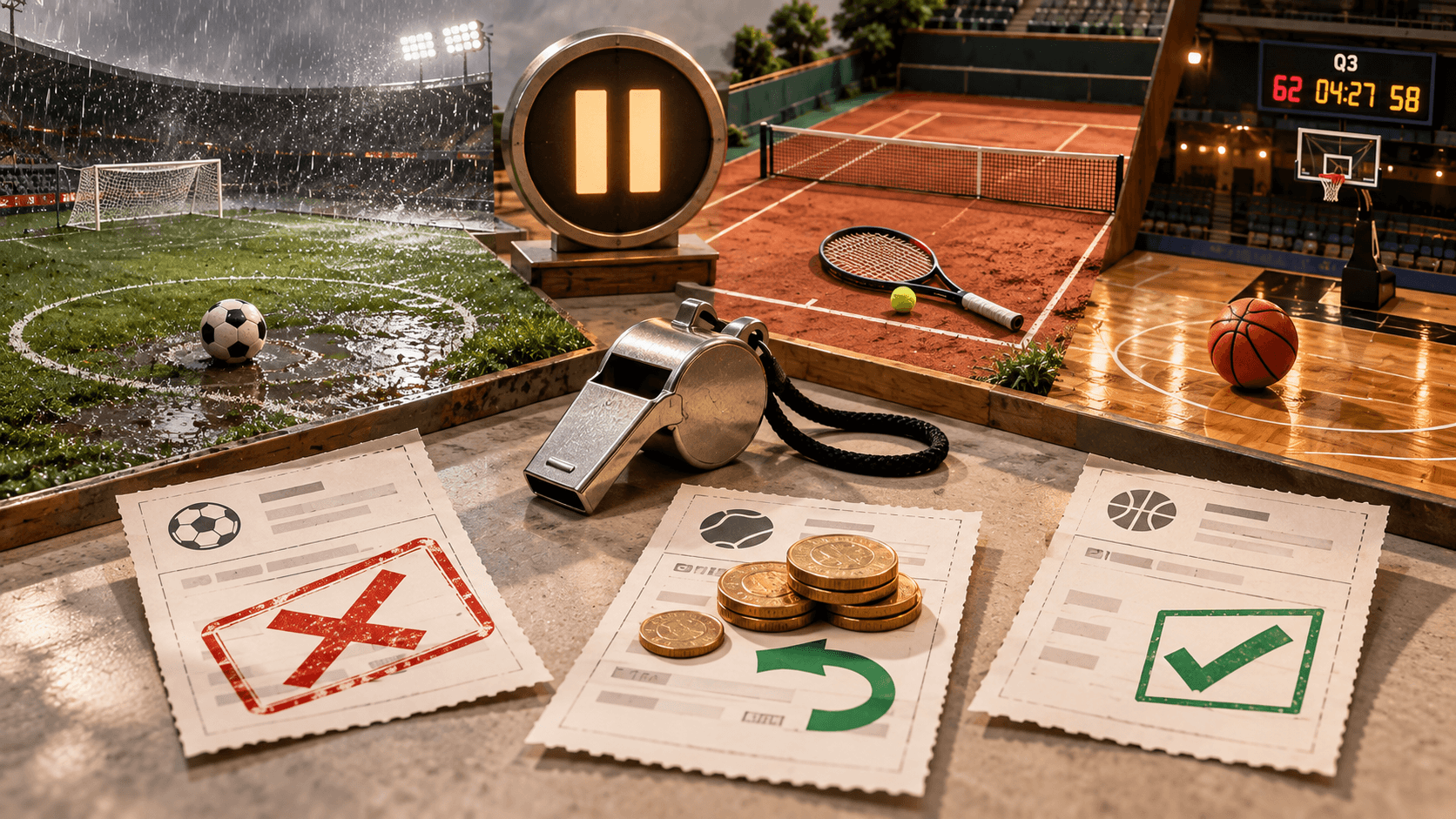
You place a bet on a football match scheduled for Saturday afternoon.
Heavy rain arrives, the pitch becomes unplayable, and the match is postponed.
What happens to your bet?
Or imagine betting on a tennis player who wins the first set but retires with an injury halfway through the second. Does your bet lose because the opponent advances, or is your stake returned?
Sports betting becomes considerably more confusing when the event does not finish as expected.
Matches are postponed. Games are abandoned. Tennis players retire. Participants are disqualified. Entire tournaments can be cancelled. And when any of these situations occur, sportsbooks have to determine what happens to the bets already placed.
The result might be a void bet, a refund, a settled win or loss, or a wager that remains active until the event is completed.
There is no single rule covering every sportsbook, sport and market.
Understanding the basic principles, however, can make these situations much easier to navigate.
First, What Is a Void Bet?
A void bet is a wager that the sportsbook decides cannot be settled normally under its rules.
In most cases, the stake is returned to the player.
Suppose you place €20 on Team A to beat Team B.
The match is cancelled and the sportsbook’s rules state that bets on cancelled matches are void.
Instead of recording the wager as a win or loss, the sportsbook returns your €20 stake.
It is effectively treated as though the qualifying bet did not produce a settled betting result.
This is different from losing the wager.
It is also important to distinguish a void bet from a promotional refund, where an operator might return money under the conditions of a particular offer.
Why Sportsbook Rules Matter So Much
Sportsbooks publish settlement rules explaining how unusual situations are handled.
These rules can cover:
- postponed matches
- abandoned events
- venue changes
- participant withdrawals
- tennis retirements
- disqualifications
- shortened games
- overtime
- cancelled tournaments
- dead heats
- incorrect event information
The important point is that two sportsbooks can sometimes settle apparently similar situations differently.
The sport matters too.
A football match abandoned after 70 minutes is not necessarily treated in the same way as a basketball game stopped in the third quarter or a tennis match ending because one player retires.
Even within one sport, different betting markets may receive different settlements.
That is why checking the operator’s sport-specific rules is more reliable than assuming every cancelled event automatically produces a refund.
What Happens When a Football Match Is Postponed?
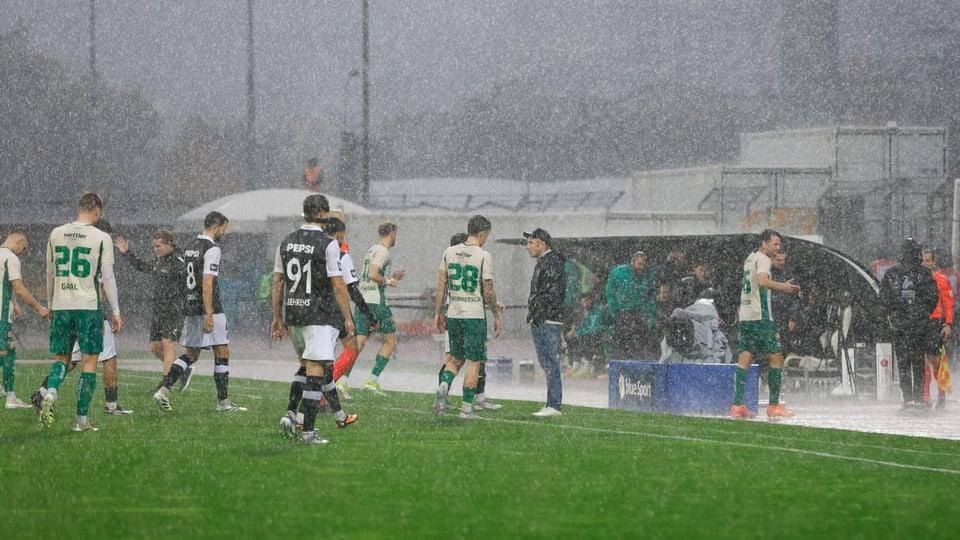
Imagine you bet on Real Madrid to win a match scheduled for Saturday.
A storm makes the stadium unsafe, so the match is postponed until Sunday.
Your bet may remain active.
Many sportsbooks allow wagers to stand when a postponed fixture is played within a specified period. That window depends on the operator’s rules.
If the match is moved beyond that period, bets may instead be voided and stakes returned.
This creates an important distinction:
Postponed does not necessarily mean cancelled.
The match still exists. Only its starting time has changed.
Before assuming that your money will be returned, check whether the sportsbook keeps bets active for rescheduled events.
What If a Football Match Starts but Is Abandoned?
Now consider a different scenario.
Team A is leading Team B 2-1 after 65 minutes when severe weather forces the referee to abandon the match.
The final result has not been officially completed.
What happens to the bets?
That can depend on both the sportsbook and the market.
A match-result bet may be void because the game did not reach the point required for normal settlement.
But some markets may already have been conclusively determined.
For example, suppose you bet:
Over 0.5 first-half goals
The first half finished 1-0 before the match was later abandoned.
Depending on the sportsbook’s rules, that market may still be settled as a winner because its outcome had already been established.
Compare that with:
Over 3.5 total match goals
Only three goals had been scored when the game stopped.
Because the match was not completed, the final outcome of that market was still unknown.
The operator may therefore void it.
This is why an abandoned match does not always mean every wager connected to it receives identical treatment.
Already Determined Markets Can Be Different
This concept appears across sports betting.
A market can sometimes be settled even when the larger event is not completed, provided its outcome was already unconditionally determined.
Suppose you bet on:
First team to score: Team B
Team B scores after eight minutes.
The match is abandoned an hour later.
The event itself did not finish, but nothing occurring after Team B’s opening goal could change which team scored first.
Depending on the sportsbook’s rules, that market may therefore remain valid.
Sportsbooks often make this distinction between markets whose outcomes are already known and markets that still depend on the unfinished portion of the event.
What Happens When a Tennis Player Retires?
Tennis is one of the clearest examples of why players should read sport-specific settlement rules.
Imagine this match:
Player A vs Player B
Player A wins the first set 6-4.
During the second set, Player B suffers an injury and retires.
Official tournament records may show Player A advancing.
But does that mean a bet on Player A automatically wins?
Not necessarily.
Sportsbooks can have different retirement rules.
Some markets or operators may require a certain amount of the match to have been completed before a match-winner bet is considered valid. Others may apply different conditions.
Individual markets create additional complications.
Consider these bets:
Player A to win the first set
The first set was completed before the retirement, so this market may already be settled.
Over 22.5 total games
The match ended early, meaning the expected number of games could never be played normally. This market may therefore be void depending on the rules.
Player A to win 2-0
Whether this market remains valid can depend on the sportsbook’s retirement and settlement policy.
The lesson is simple: an official winner and a betting-market winner are not always the same thing.
Walkovers Can Be Different Again
A walkover normally occurs before a match begins.
Suppose Player B withdraws because of illness before the first point is played.
Player A advances to the next round without competing.
From a tournament perspective, Player A progresses.
From a betting perspective, however, many wagers may be void because the match itself never began.
Again, the operator’s rules determine the actual settlement.
This distinction matters particularly in tennis, where withdrawals and retirements are relatively common.
What About Disqualified Players?
Disqualification introduces another layer of complexity.
Imagine a tennis player being disqualified after an incident during a match.
Or a motorsport participant being excluded following a rules violation.
The settlement can depend on when the disqualification occurred and what the sportsbook considers the official result.
Some operators may settle according to the governing body’s result at a specified point.
Others may have rules stating that later amendments, appeals or disqualifications do not change bets that have already been settled.
This is sometimes connected to the concept of the podium or weigh-in rule, particularly in racing and similar sports.
The sportsbook’s terms usually explain when a result becomes final for betting purposes.
Basketball Creates Different Problems
Basketball presents another useful example because games can be postponed, interrupted or shortened.
Suppose you bet:
Lakers vs Celtics – Over 220.5 points
The game is stopped in the third quarter because of an arena problem.
At that moment, the teams have combined for 165 points.
The final total cannot yet be known.
If the game is not resumed within the period required by the sportsbook, the total-points market may be void.
Now imagine the same game is temporarily suspended but resumes two hours later and reaches its normal conclusion.
In that case, the bet may remain active and be settled using the completed result.
The difference between suspended, postponed, abandoned and cancelled can therefore matter.
These words may sound similar to a casual bettor, but they can lead to different settlement outcomes.
What If a Tournament Is Cancelled?
Individual matches are not the only events that can disappear.
Suppose you bet on a golfer to win a tournament.
After the opening round, extreme weather forces organizers to cancel the rest of the competition.
What happens?
The answer may depend on whether the governing body declares an official winner.
If no official tournament result exists, outright bets may be void.
If organizers shorten the tournament and officially declare a winner based on the completed rounds, the sportsbook may use that result, depending on its rules.
Similar situations can arise in tennis, motorsport and other tournament-based sports.
Once again, the sportsbook’s definition of an official result matters more than simply whether the event followed its originally planned format.
Cancelled and Shortened Are Not the Same
A tournament does not always need to reach its originally scheduled length to produce an official result.
Weather might reduce a golf tournament from 72 holes to 54.
A competition format could change after disruption.
A race could be stopped early but still produce an official classification.
Sportsbooks may recognize those official results if their settlement rules allow it.
That means players should not automatically expect a void bet simply because an event was shortened.
The key questions are:
Was an official result declared?
and
Does the sportsbook recognize that result for the market you bet on?
What Happens to Accumulator Bets?
Accumulator bets can make void settlements look more complicated than they really are.
Suppose you place a four-team football accumulator:
Team A to win
Team B to win
Team C to win
Team D to win
Team C’s match is cancelled and that selection is void.
At many sportsbooks, the entire accumulator is not automatically cancelled.
Instead, the void selection is effectively removed from the calculation, commonly by treating it at odds of 1.00.
Your four-team accumulator therefore becomes a three-team accumulator.
Imagine the decimal odds were:
Team A: 1.80
Team B: 2.00
Team C: 1.70 – void
Team D: 1.50
Originally:
1.80 × 2.00 × 1.70 × 1.50 = 9.18
After Team C is voided:
1.80 × 2.00 × 1.00 × 1.50 = 5.40
The bet can still win if the remaining selections win, but the potential return is lower.
This is one of the most useful rules for beginners to understand.
One void selection does not necessarily void the entire accumulator.
Operator rules and certain bet types can produce exceptions, so the specific terms still matter.
What If Every Selection Is Void?
Suppose you place an accumulator and every selection is ultimately void.
There are no remaining results from which to calculate a winning return.
Under common settlement approaches, the stake would be returned.
Similarly, if you place a single bet and that selection is void, you would normally receive your stake back rather than a winning payout.
This is why seeing “void” in your betting history should not automatically be interpreted as a loss.

What About Same-Game Parlays?
Same-game parlays can be more complicated.
These products combine multiple selections from one sporting event, such as:
Team A to win + Player X to score + Over 2.5 goals
If one component becomes invalid, the operator may have specific rules governing whether the entire bet is void, recalculated or settled another way.
Unlike a traditional accumulator involving separate events, the selections can also be mathematically related.
For that reason, bettors should check the sportsbook’s specific same-game parlay rules rather than assuming the standard “void leg becomes 1.00” principle always applies.
Refund Does Not Always Mean Void
The terms “refund” and “void” are often used interchangeably by players, but they can describe different situations.
A void bet usually means the wager cannot be settled normally under the sportsbook’s betting rules, so the stake is returned.
Returning a void stake and processing a withdrawal are also separate processes. Fast Payout Casinos – What Really Determines How Quickly You Get Your Money in 2025 explains why payment methods, verification and internal processing can affect how quickly money actually reaches a player.
A refund promotion might instead be a marketing offer.
For example:
If your team loses after leading at half-time, we’ll refund your stake as a free bet.
The original wager still lost.
The sportsbook is simply providing promotional compensation.
That is different from a bet being void because the underlying event or market could not be settled.
Understanding the distinction can prevent confusion when reviewing account history.
Do Postponed Bets Lock Up Your Money?
Potentially, for a while.
If the sportsbook keeps a bet valid while waiting for a postponed event to be rescheduled, the stake may remain committed to that wager.
The player may not immediately receive a refund simply because the original starting time has passed.
How long the bet can remain open depends on the sportsbook’s rules and the sport involved.
This is another reason to check postponement rules before betting on events that appear vulnerable to weather, scheduling problems or other disruptions.
Can a Sportsbook Change a Result After Paying a Bet?
Sometimes official sporting results change after an event.
A participant might later be disqualified.
A governing body could correct a scoring error.
An appeal might alter a classification days later.
Sportsbooks generally establish a point at which results become final for settlement purposes.
Once that point has passed, later changes may not affect settled bets.
But policies vary.
This protects sportsbooks and bettors from situations where a wager could theoretically remain uncertain for days or weeks while every possible appeal is resolved.
The relevant operator’s settlement rules should specify which official source is used and when the result is considered final.
What Should You Check When a Sporting Event Is Interrupted?
If an event you have bet on is postponed, abandoned or cancelled, avoid assuming what will happen based on another sportsbook’s rules.
First, check the status of the event itself.
Has it been postponed?
Suspended?
Abandoned?
Officially cancelled?
Then check your sportsbook’s rules for that particular sport.
Look specifically for sections covering postponements, abandoned events, retirements, walkovers and settlement.
Finally, check the individual market.
A match-result wager and a first-half market may be treated differently even though they relate to the same interrupted match.
A Practical Example
Imagine three bettors place wagers on the same football match.
The match is abandoned after 72 minutes with Team A leading 2-1.
Bettor 1: Team A to win the match.
The final result was not completed. Depending on the sportsbook’s abandonment rules, the wager may be void.
Bettor 2: Over 1.5 total goals.
Three goals had already been scored before abandonment. If the operator settles markets that were unconditionally determined, this wager may remain a winner.
Bettor 3: Team A to score over 2.5 goals.
Team A had scored only twice. Because the match ended early, it was still possible for the target to be reached if play had continued. The market may therefore be void rather than settled as a loss.
All three players bet on the same match.
All three could receive different settlement outcomes.
That illustrates why the individual market matters just as much as the event status.
What If You Disagree With the Settlement?
Start with the sportsbook’s published betting rules.
Find the section covering the sport and specific situation involved.
Then compare that rule with the official event status and your bet details.
Keep records such as:
- bet ID
- market name
- odds
- stake
- event date
- screenshots
- official result
- sportsbook settlement
If the settlement appears inconsistent with the operator’s own rules, contact customer support and ask for an explanation referencing the relevant rule.
Clear settlement rules and effective dispute handling are also important indicators of operator reliability, a broader idea explored in Casino Transparency Scores – Could Players Soon Rate Platforms Like Credit Scores?
For regulated operators, players may also have access to a formal complaints process and, depending on the jurisdiction, an approved alternative dispute resolution service.
The exact escalation route depends on where the sportsbook is licensed.
Why Rules Differ Between Sportsbooks
Sports betting markets cover an enormous variety of competitions.
Football matches have different structures from tennis matches.
Basketball has overtime.
Baseball can be shortened by weather.
Golf tournaments can be reduced in length.
Motorsport results can change because of penalties and disqualifications.
Sportsbooks therefore create detailed rules defining what constitutes a valid event and a valid result for each market.
This means there is rarely a universal answer to:
“My event was cancelled. What happens to my bet?”
The more useful question is:
“Under my sportsbook’s rules, what happens to this specific market when this type of event is interrupted?”
Final Thoughts
Cancelled and interrupted sporting events are confusing because the sporting result and the betting result are not always identical.
A postponed football match may leave your bet active.
An abandoned match may cause some markets to be void while already determined markets remain valid.
A tennis retirement can be settled differently depending on how much of the match was completed and the sportsbook’s rules.
A shortened tournament may still produce valid bets if an official result is declared.
And in an accumulator, one void selection may simply be removed while the remaining legs continue.
The most important principle is therefore simple:
Do not assume that cancelled means refunded, postponed means void, or an official winner automatically means a winning bet.
Check the event status, the individual market and the sportsbook’s settlement rules.
Those three pieces of information usually determine what happens next.
Sources: